Place the Property in Its Market
We determine whether a property sits in the downtown core, an industrial corridor tied to cross-border trade, or a retail node shaped by currency and traffic patterns.

Windsor sits at Canada’s busiest border crossing, its economy driven by automotive manufacturing and reshaped by major infrastructure investment, including the new Gordie Howe International Bridge and expanding EV battery production. RealEx provides commercial real estate appraisal in Windsor, Ontario, a core market shaped by major infrastructure investment.
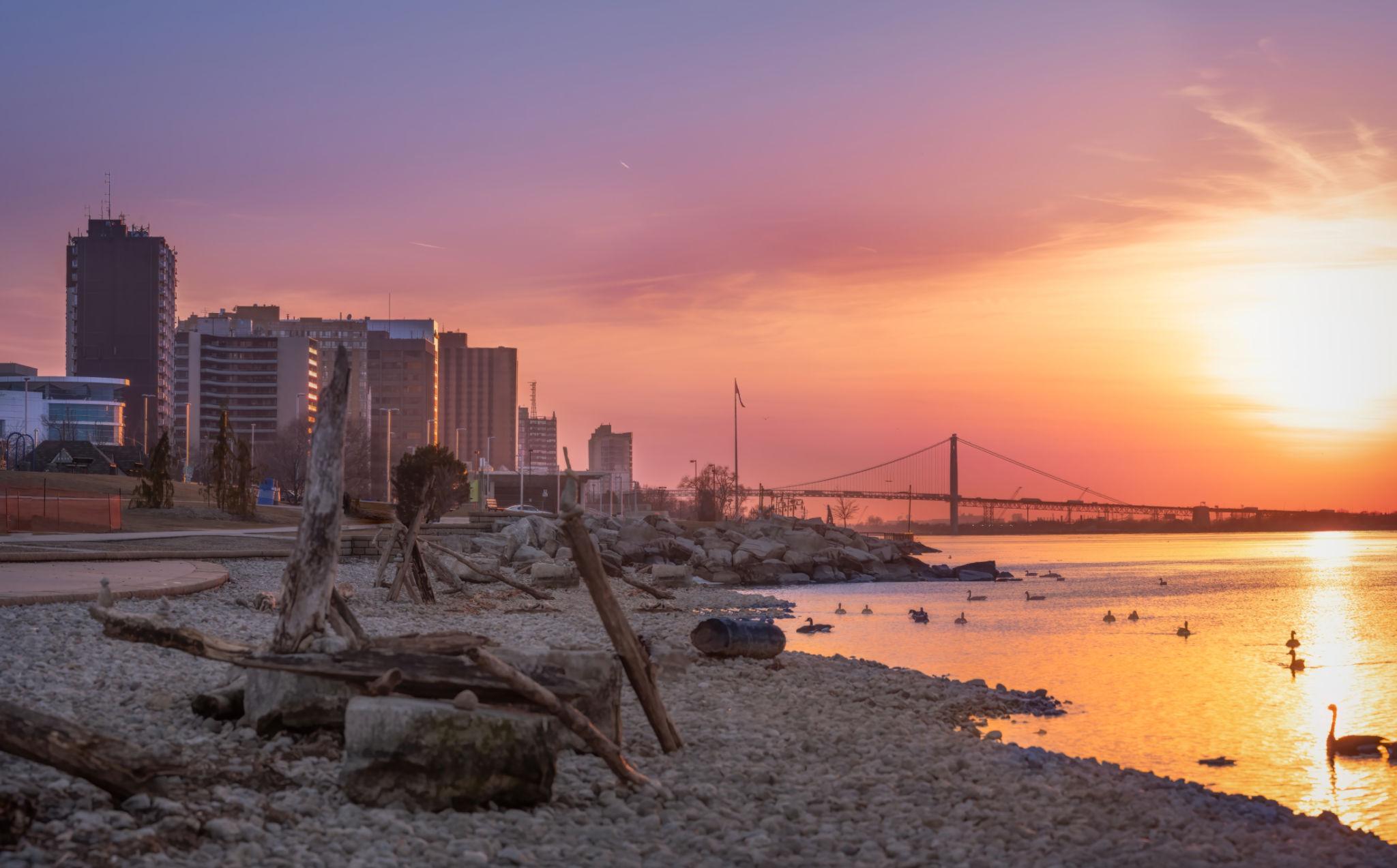
Windsor’s commercial real estate story in 2026 is dominated by two infrastructure projects landing at nearly the same time. The Gordie Howe International Bridge, a $5.7 billion crossing connecting Windsor to Detroit, had its bridge deck completed in June 2026, marking the first new Windsor-Detroit crossing in more than 60 years and doubling the number of access lanes between the two cities. NextStar Energy’s $5 billion electric vehicle battery plant, a joint venture originally between Stellantis and LG Energy Solution, is now operating with more than 1,300 workers hired toward a target of 2,500. Together with other regional projects, total committed infrastructure investment in Windsor-Essex now exceeds $11 billion. That said, CBRE’s own 2026 commentary flags a real counterweight: tariff and CUSMA uncertainty is slowing Southwestern Ontario’s broader auto sector, directly affecting the region’s industrial real estate market. RealEx treats the bridge and battery plant as genuine, active demand drivers, while accounting for that trade-policy uncertainty rather than assuming unconstrained growth.
Ouellette Avenue, Windsor’s main north-south commercial street, functions as the city’s downtown core. The Gordie Howe Bridge is specifically designed to bypass downtown, routing commercial and cross-border traffic away from the traffic-light bottleneck that currently slows approaches to the older Ambassador Bridge. Downtown traffic patterns will shift as a result, while industrial land near the new crossing gets stronger.
Chatham-Kent’s 2023 Municipal Comprehensive Review projects the municipality’s population reaching roughly 122,200 by 2051, requiring an estimated 8,290 new households and adding close to 5,100 new jobs, with Chatham expected to capture roughly 59% of that employment growth. The plan specifically examined settlement area boundary expansions in Chatham, Tilbury, Dresden, and Blenheim, and separately flagged a land supply and demand mismatch in Wallaceburg between where urban land is designated and where housing demand is actually landing. Council approved the growth framework in July 2026. For land near any of those four expansion areas, or in Wallaceburg specifically, that approved framework is a more current reference point than existing zoning alone. Development charges apply across the municipality on new construction, and Bloomfield Business Park’s industrial exemption, noted above, is a direct and material exception to that general rule.
Reading a market correctly when it’s being pulled two directions at once, real infrastructure investment on one side, genuine trade uncertainty on the other, takes judgment as much as data. That’s what Alex Rance brings to Windsor: AACI and P.App designated, holding the Personal Level Endorsement, and currently Chair of the Appraisal Institute of Canada’s London Chapter. He’s also a working property owner in Southwestern Ontario, managing his own leasing and development approvals rather than only advising on other people’s.

Windsor’s commercial market calls for a process that accounts for its border-driven economy, so we work through four steps on every file:
Windsor’s border economy, from cross-border logistics to major manufacturing investment, means our reports land in front of a wide variety of readers. We calibrate each file’s depth and format to its intended use.
The clients we typically serve include:
No. Land near the corridor has already been pricing in anticipated logistics and manufacturing demand for some time, though we weigh that against real uncertainty in the broader auto sector tied to current tariff and trade policy conditions.
It’s concentrated in industrial and manufacturing-adjacent properties specifically. Institutional space, medical office, and well-located retail haven’t seen the same pressure, which is why each asset class gets assessed on its own terms rather than one blanket market read.
The centre’s performance can take a real hit, but well-positioned smaller retail nearby, particularly along a corridor like Howard Avenue, often keeps performing on its own separate fundamentals rather than following the anchor space down.
Downtown’s traffic character will shift, but Ouellette Avenue’s value has never depended solely on cross-border traffic passing through, its retail and dining base draws on the surrounding downtown population and workforce directly.
It’s still speculative. Early investor interest is real, but values tied to a not-yet-settled traffic pattern and still-maturing corridor carry more risk than an established commercial node would.
Workforce growth toward the plant’s full hiring target supports steady demand for nearby housing and services, but that demand builds in step with actual headcount, not the plant’s eventual full capacity on day one.
It depends on property type, size, and complexity, a small retail unit and an industrial site near the Gordie Howe Bridge corridor are priced very differently. Contact RealEx directly for a quote specific to your property.
A current site plan or survey, your most recent property tax assessment, existing leases or rent rolls, recent capital improvement records, and any existing environmental site assessments, which matter more for industrial land in this corridor than they would for a standard retail unit.
If you need a commercial real estate appraisal or advisory support in Windsor, Ontario, RealEx Inc. is ready to assist. Contact our team to discuss your property, its location and corridor, your timeline, and your reporting requirements.